

BOOK TWO · THE ADAPTIVE MARKETER SERIES
The operating system for marketing, sales, and success.
Build a go-to-market that learns while it moves.
Pre-order now Look inside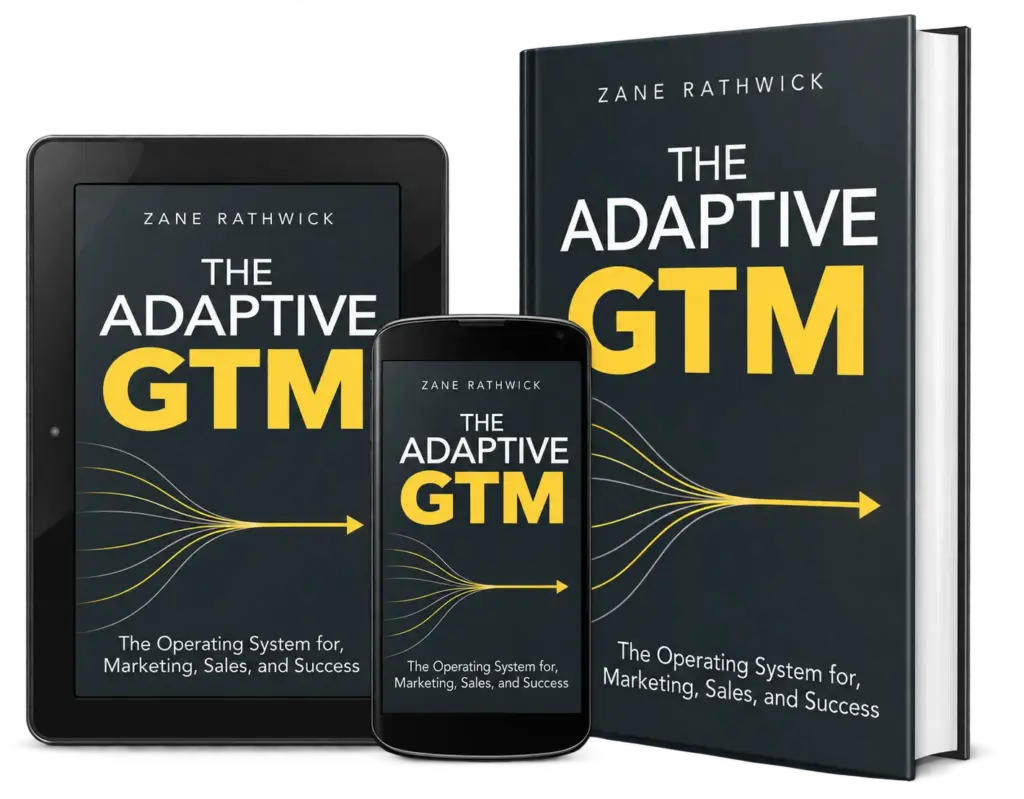
Build a go-to-market that learns while it moves.
Pre-order now Look inside
The funnel assumes a buyer who moves in a straight line. That buyer doesn’t exist. Real buyers loop, stall, ghost, and come back. The fix isn’t a better playbook — it’s a different shape entirely.
The Adaptive GTM hands you an interlocking model you can actually run — and keep running as the market changes. It turns on one engine :
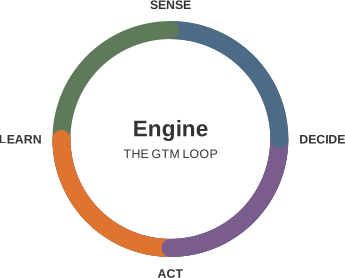
Sense → Decide → Act → Learn, turning continuously. It finds the answer in real time — and keeps finding it as the answer changes.
Pattern over Playbook · Friction over Funnels · Context over Channels · Coherence over Cosmetics · Signals over Schedules
Every motion runs on a kind of ground. The same play that wins on one terrain is fatal on another.
The Pattern Grid connects signal to play. The Change Budget paces adaptation. The Coherence Audit keeps speed from fragmenting your story.
Most teams run the same plays everywhere and wonder why some land and some don’t. They don’t account for the ground. These are the six kinds a GTM motion runs on:
Many small segments, none dominant. Go deep on one beachhead, not wide.
Everyone sounds the same. Sharpen your “why we exist.”
One giant owns the space. Wedge in where they underdeliver.
Two motions in conflict. Align both under one ICP, design the handoff.
Only price differentiates. Repackage; own an uncopyable value story.
Nailed fit, then flatlined. Test adjacent segments in small bets.
Not theory — capabilities. By the end you’ll run your GTM as a system that senses, moves, and gets smarter every cycle.
Turn a fixed plan into a living cycle — sense signals, decide, act, and learn, continuously, so your GTM improves with every turn.
Diagnose which of the six terrains you’re on and pick plays that fit the ground — instead of running the same playbook everywhere.
Use the Signal Pyramid to spot the qualitative whispers that predict what’s coming, long before they show up in a dashboard.
Assemble a GTM stack and an adaptive team designed for velocity through insight, not raw throughput.
Pace adaptation deliberately with the Change Budget, so “adapt fast” never tips into organizational burnout.
Run experiments constantly while the Coherence Audit keeps marketing, sales, and CS telling one story — not three.
The Adaptive GTM is written for the people who own the whole revenue motion, not just one channel.
You’re a marketing, sales, or CS leader tired of playbooks that stop working the moment the market shifts.
You’re a founder or revenue leader who needs one coherent GTM motion, not three departments pulling apart.
You want to move fast without the chaos — adapt constantly while keeping your story coherent.
You’re staring down a hard terrain — a dominant incumbent, a commoditizing category, a post-PMF stall.
You’d rather have a system you can run than another list of tactics to try.
You want to put AI to work in your GTM without losing the human read on the market.
The Adaptive CMO is organized into five parts that follow the GTM Loop — By the end you’ll run your GTM as a system that senses, moves, and gets smarter every cycle.

I’ve spent twenty-plus years running B2B SaaS marketing, watching smart people do expensive things for defensible reasons, and signing off on a few myself. Startups scrounging for traction, companies in the blender of an acquisition, teams white-knuckling a public launch. Different logos, same job: figure out what the market is telling you before the competition does, and move before the window shuts.
Here’s what I couldn’t unsee: smart, funded, talented teams optimizing the wrong loop, faster. Heroic effort poured into an annual plan the market had quietly divorced in March. More content, more campaigns, more dashboards measuring the wrong thing to two decimal places. Everyone exhausted. Nobody moving. We called it execution. It was mostly motion.
This book come from the the real world, not a conference stage where the case studies always work out. The examples are mine; I was in the room, usually the one on the hook for the number. I’ll repeat this until you want to throw the book across the room: marketing should get smarter as it moves, not in a retrospective, where insight becomes a slide nobody opens.
The complete operating system for a go-to-market that learns while it moves. Yours to put to work this week.
Pre-order now