

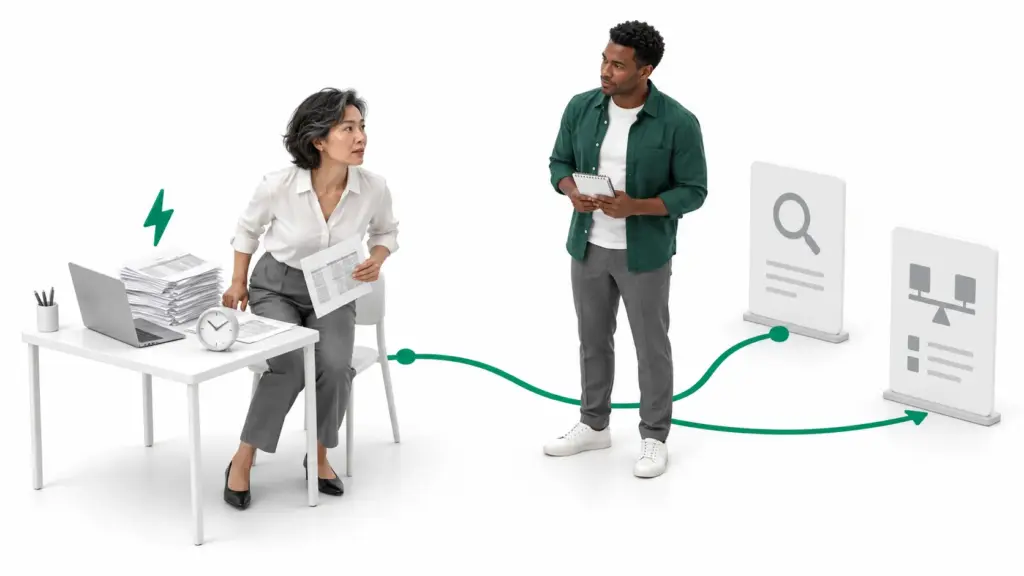
Ask most marketing teams why a customer bought, and you’ll get an answer about the product. The onboarding was smooth, the ROI calculator was compelling, the case study closed the deal. All plausible. All probably contributed something. None of them explain why that customer started looking in the first place, on that particular week, instead of six months earlier or six months later.
Something happened first. Katelyn Bourgoin’s work on trigger events is the clearest breakdown I’ve found of what that something usually is, and once you start looking for it, you can’t really stop noticing it in every deal you’ve ever closed, which is either a useful skill or a mild personality flaw at dinner parties.
Buying doesn’t start with research. It starts with a jolt.
A trigger event is the specific moment that knocks someone out of “this is fine” and into “I need to fix this now.” A new hire joins and is horrified by the current process within a week. A vendor renewal shows up with a number nobody budgeted for. A deadline gets missed badly enough that someone senior asks what happened. A person spends one more night manually reconciling spreadsheets and finally has enough.
None of that is research. It’s a jolt. Research comes after, once the jolt has already convinced someone the current situation is no longer tolerable. This matters more than it sounds like it should, because most marketing is built entirely for the research phase — comparison pages, feature breakdowns, ROI calculators — and almost none of it is built for the jolt itself, which is the actual moment that decides who even makes it onto the shortlist.
Why “we needed a better tool” is never the real answer
Ask a customer why they bought and the first answer is almost always too polished: “we needed a more efficient solution.” That’s the story they’ve since told themselves, cleaned up and reasonable-sounding, roughly the customer-interview equivalent of putting on a blazer for a video call when you’re wearing sweatpants underneath.
Getting to the real story means asking differently. Not “why did you buy this,” but “walk me through the week you started looking” — and then staying quiet, resisting the urge to fill the silence, which I’m bad at, having once asked a follow-up question so quickly after my own question that the customer hadn’t technically started answering yet.
Stay quiet anyway. The real answer usually shows up two or three follow-ups later, after the polished version has run out of things to say. I’ve had this conversation enough times to notice the pattern: the tidy explanation comes first, almost automatically, like it was pre-approved by legal. The real trigger comes out sounding smaller and a little more human — and it’s always more useful than the tidy version, because it’s the thing that’s actually true.
What to do with a trigger once you’ve found one
Collect five or six real trigger events across real customers and a pattern usually shows up fast. Not fifty scenarios. Three, maybe four, that cover most of how people actually end up buying — a number so much smaller than what most positioning decks imply that the first time it happens, it feels like you’ve made an arithmetic error somewhere.
Content, ads, even sales talk tracks can be built around the actual trigger instead of the abstract category. “5 Signs Your Current Process Isn’t Scaling” is fine, forgettable, the kind of headline that could belong to anyone with a keyboard. “What to Do the Week After You Miss a Deadline in Front of Your Boss” is uncomfortably specific, and specific is exactly what makes someone stop scrolling — because they recognize the week you just described as their own, and now they’re a little worried about how you knew.
The habit worth keeping
I ask every new customer, in the first real conversation, what actually got them looking. Not as a formality — the honest answer is usually more useful than three months of dashboard data, and it costs nothing but the willingness to ask a slightly awkward question, then actually wait for the real answer instead of grabbing the first, tidier one they hand you on the way out the door.