

For most of the SaaS era, the deal was simple. You bought software. Your employees logged into it, learned where everything lived, and clicked through six screens to accomplish something that sounded deceptively easy in the sales demo. Buy enough SaaS products and you eventually accumulate an impressive collection of browser tabs, forgotten passwords, tangled integrations, and quarterly conversations about why nobody’s using half the software you’re paying for.
That model has had a very good twenty-five-year run. Salesforce and Anthropic may have just shown us what comes after it.
In August, the two companies announced Claudeforce, an expanded partnership connecting Claude directly to Salesforce’s data, workflows, business logic, permissions, and actions. The first version gives Claude 37 prebuilt Salesforce sales skills — reviewing pipeline, prepping for meetings, analyzing deal health, updating CRM records, all without anyone opening Salesforce itself.
But the interesting part isn’t the 37 skills. It’s the architecture underneath them.
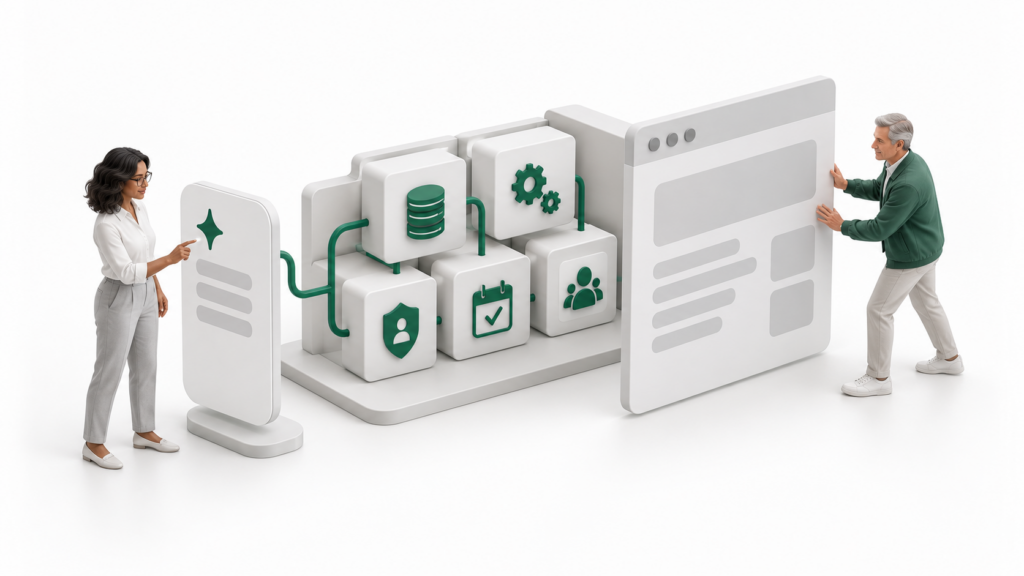
Salesforce calls it Headless 360. Instead of forcing every person or AI agent through a Salesforce interface, the company is turning pieces of its platform into reusable capabilities that Claude, ChatGPT, Slack, or whatever comes next can reach directly — not just APIs, but the rules, permissions, workflows, and governance required to actually do the work safely. Salesforce says the quiet part out loud: enterprise software spent decades optimizing for humans clicking through applications. The next generation optimizes for AI agents completing work across them.
That sentence should get every SaaS company’s attention, because the future of the category may have a lot less to do with the app.
The interface is separating from the software
We’ve always treated the application and the interface as one product. Salesforce is the Salesforce screen. HubSpot is the HubSpot screen. Workday is the Workday screen. Want something from the software, go there.
Agents break that assumption. Say I ask Claude which enterprise deals are most at risk this quarter, why, and what my team should do about it. Claude checks Salesforce, then maybe Gong, then Slack, maybe support tickets, product usage, my calendar. It identifies three accounts, explains what’s happening, drafts follow-ups, schedules meetings, updates the opportunity records, and creates tasks for the right people. I never opened Salesforce. Or Gong. Possibly anything besides Claude.
The software still did the work — arguably more of it than if I’d run through each step myself. I just never visited it. That’s a real change in what an application is. The interface used to be the product. Increasingly, it’s just one way to reach it.
SaaS is becoming a capability layer
Salesforce’s own wording is telling here. It isn’t just exposing Salesforce data to Claude — it’s exposing business capabilities, and the difference matters. An API lets an AI pull an opportunity record. A capability lets it understand that opportunity, know what actions are permitted, follow the org’s rules, run the correct workflow, and update the system properly.
That starts to turn SaaS products into something closer to infrastructure. Your CRM becomes a set of revenue capabilities. Your marketing platform becomes audience, campaign, and orchestration capabilities. Your finance system becomes financial operations. Your HR platform becomes workforce capabilities. The agent sits above all of it, working across the whole stack at once.
Salesforce describes Headless 360 as turning every cloud into reusable capabilities that authorized agents can discover and invoke — already supporting open standards like MCP, and built to serve agents from Salesforce, Anthropic, OpenAI, Google, AWS, and presumably whoever else shows up next. Which tells you something else: Salesforce is no longer assuming it owns the front door forever. For a company that spent decades building one of the most valuable front doors in enterprise software, that’s not a small call to make.
The battle shifts from owning the screen to owning the context
None of this makes Salesforce less important. It might make it more important, because once the AI becomes the interface, something underneath still has to know how the business actually runs. Who owns this account? What price did we quote? What counts as an approved discount? What happens after legal signs off on the contract? What happened the last six times this customer called support?
AI models reason well. They’re a lot less useful without reliable context, which suddenly makes something we’ve spent years taking for granted very valuable again: the system of record. The platforms sitting on ten or twenty years of customer data, business rules, permissions, and institutional memory aren’t necessarily getting displaced by AI. They may become the ground it has to stand on.
Salesforce CEO Marc Benioff described the pairing as probabilistic intelligence from Claude paired with deterministic enterprise systems from Salesforce — a useful line. Claude reasons about what should happen. Salesforce knows what can happen, who’s allowed to do it, and what rules apply. Intelligence on top, trusted business context underneath. That shape may become the default architecture for enterprise AI.
The most vulnerable SaaS products are the ones without much underneath
This is where things get uncomfortable for parts of the SaaS market. For years, a decent-looking interface wrapped around a database and a workflow was enough to build a perfectly respectable business. There are thousands of them. AI makes that position a lot less comfortable, because if your app’s main value is giving a human a slightly better screen for entering, retrieving, or summarizing information, an agent may be able to do most of that without ever touching your interface — especially once the underlying systems expose their capabilities through common standards.
A lot of SaaS products do some version of: pull data from System A, reformat it, apply a little logic, push it to System B, show a dashboard, email someone, wait for a click, update a field. That made sense when a human had to run every step. Agents don’t care about the screens. So the moat moves to whatever sits behind them — unique data, proprietary workflows, real domain expertise, governance, hard-to-reproduce integrations, embedded business logic. Something an agent genuinely can’t route around. The companies without much of that may find a pleasant UI isn’t enough of a reason to exist anymore.
Integrations become less valuable. Or much more valuable.
There’s an odd contradiction building here. AI should make it dramatically easier to connect software — open protocols like MCP give agents a common way to discover and use tools, and Salesforce’s Headless 360 lets an agent find available operations on its own instead of requiring developers to expose thousands of functions by hand. That should make basic integration cheaper, and the old “2,000+ integrations” badge on a SaaS feature list starts to matter less if an agent can increasingly figure out how to work with a system itself.
But deep integration gets more important. Giving an AI permission to read something is easy. Letting it safely change pricing, send customer communications, issue a refund, modify a contract, or move a seven-figure opportunity through the pipeline is a different problem entirely — one that needs governance, identity, permissions, auditability, and real business rules behind it. Integration stops meaning “can these two systems connect” and starts meaning “can an intelligent system safely operate across them.” That’s a much higher bar, and not every vendor is going to clear it.
Seat-based pricing is going to get strange
SaaS economics were built around humans: one employee, one login, one seat, $79 a month, nice clean spreadsheet. But what’s a seat worth when an AI agent is doing the work of five people across a dozen applications? If nobody logs into your product but the company’s AI hits your system 40,000 times a day, is that customer using your software less? Clearly not — they may be using it considerably more.
This is why the death-of-SaaS argument has always felt too simple to me. Agents may eliminate huge amounts of traditional software interaction while simultaneously driving more software usage underneath it — and that possibility is already showing up in how investors think about the sector, with recent analysis pointing to agents potentially increasing overall application usage since machines can interact with software far more often than people ever could.
Pricing has to catch up. Per-seat pricing made sense when value tracked headcount; that relationship weakens once agents become users too. Expect more blends of platform fees, consumption pricing, per-transaction charges, and outcome-based models — Deloitte has made a similar case that agentic SaaS will force vendors to rethink their traditional sales and pricing playbooks. Somewhere, a CFO is about to receive the first invoice itemizing 14 million “agent actions” and have a small moment of personal growth. We’ll figure it out.
Product adoption becomes harder to see
Here’s an implication I haven’t heard discussed nearly enough: our entire idea of product adoption assumes a human is using the product. Logins, sessions, feature adoption, time in app, monthly active users. Those metrics get strange fast once agents are acting on a user’s behalf. A customer could become deeply dependent on your platform while the number of humans actually opening your app quietly declines. Traditional analytics might say engagement is falling. The business reality could be the opposite.
SaaS companies will need to start measuring capability consumption instead of just interface engagement — what actions are being performed, which workflows get invoked, how often agents are calling the platform, how much of the customer’s business logic now lives inside it. That may end up a far more meaningful measure of stickiness than daily active users. The best SaaS product going forward might be the one you almost never open.
The stack may consolidate at the top and explode underneath
For fifteen years, software stacks kept expanding because every business problem seemed to deserve its own SaaS app — marketing alone managed to acquire tools for email, intent, ABM, enrichment, attribution, personalization, webinars, and a dozen other categories, mostly because everyone had too much budget in 2021. AI pushes the opposite direction at the interface level: people gravitate toward a handful of primary environments — Claude, ChatGPT, Slack, Teams, whatever’s next — and from there, agents reach into dozens or hundreds of systems behind the scenes.
So the visible stack shrinks. The invisible one may actually grow. That builds a new kind of platform power, where the winner doesn’t need to own every capability — it needs to orchestrate them. And the individual SaaS vendor doesn’t need users living inside its app anymore. It needs to be indispensable to whatever’s doing the orchestrating. That’s a genuinely different product strategy than the one most teams were built around.
Your API may become more important than your homepage
This changes how product teams should spend their time. For years, they obsessed over the human interface — navigation, dashboards, onboarding flows, button placement. Still matters, because humans aren’t going anywhere. But there’s a second user now, and the agent doesn’t care whether your dashboard won a design award. It cares whether your system is understandable, discoverable, permission-aware, well-structured, and reliable enough to act on.
The new question for a product team is how easy it is for intelligence outside the application to use what you built — almost the inverse of traditional SaaS thinking, which spent years trying to pull users into the product. The next generation may win by making the product useful everywhere else instead.
Marketing changes too
If software gets less visible, SaaS marketing has a problem. Differentiation has historically lived inside the product — our interface is easier, our dashboard is better, our workflow takes three clicks instead of seven, watch this two-minute demo. That story gets weaker fast when nobody’s clicking anything.
SaaS companies will need to move the story up a level: what proprietary capability do you provide, what does your system understand that others don’t, what can an organization accomplish with you that it genuinely can’t without you? Honestly, that’s a better story than the click-count pitch. We probably should have been telling it all along.
SaaS isn’t disappearing. Its shape is changing.
Plenty of people have predicted AI will kill SaaS. I don’t think that’s what Salesforce and Anthropic are actually showing us. It’s something more interesting — the application splitting into layers. The interface increasingly belongs to AI. The reasoning comes from foundation models. The data, workflows, business logic, permissions, and governance stay in enterprise platforms. Agents orchestrate across all of it.
Salesforce’s answer to AI isn’t building higher walls and demanding users stay inside them. It’s making Salesforce available outside Salesforce — which may turn out to be one of the more important strategic moves in this era of software.
For twenty-five years, the question software companies asked was how to get more people using their application. The better question now might be how to make your capabilities essential to whatever’s actually doing the work. Those sound similar. They aren’t. One optimizes for visits. The other optimizes for value. And if agents really do become the primary way enterprises reach their software, some of the most important SaaS products in the world may end up being the ones their customers almost never see.